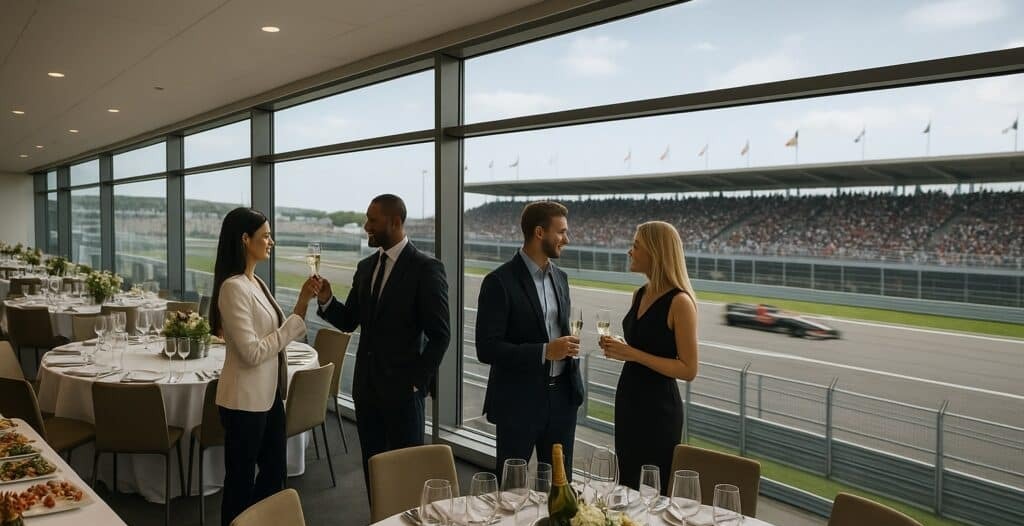
Article 03 | Beyond Attendance: How Motorsport Organisations Could Rethink Hospitality ROI
In my previous articles, I explored two connected themes.
First, I argued that motorsport organisations may increasingly need to think beyond race-day experiences and instead focus on building long-term relationship ecosystems.
Second, I suggested that Formula 1's growing popularity may accelerate this shift, as finite assets such as hospitality spaces and paddock access become increasingly constrained.
That naturally leads to another question.
How do organisations measure whether these experiences are actually creating value?
Because simply knowing that hospitality is in high demand doesn't tell us whether it's delivering meaningful outcomes.
In many industries, success is often measured by utilisation:
- Were all the seats filled?
- Were all the invitations accepted?
- Was attendance high?
These are useful metrics, but they only tell part of the story.
Attendance measures activity, it doesn't necessarily measure value.
I suspect motorsport organisations will increasingly need to move beyond measuring access and instead focus on measuring outcomes.
Hospitality is a business tool, not an event
Hospitality is often viewed as one of motorsport's most valuable commercial assets.
For good reason, it provides opportunities to strengthen relationships, facilitate conversations and create memorable experiences.
However, the true value of hospitality rarely comes from the event itself.
It comes from what happens afterwards.
- Did a sponsor strengthen an existing relationship?
- Did an executive build a new business connection?
- Did a prospect move further along a sales journey?
- Did a partner become more engaged with the organisation?
These outcomes are harder to measure, but they may be significantly more valuable.
As motorsport organisations continue to grow, I suspect this distinction will become increasingly important.
Especially if access itself becomes a constrained asset.
From attendance metrics to relationship metrics
If organisations are investing heavily in hospitality, then success may need to be measured differently.
Questions worth asking could include:
- Relationship growth: How many new strategic relationships were established?
- Commercial opportunities: How many introductions led to meaningful follow-up conversations?
- Partner retention: Did hospitality contribute to stronger long-term partnerships?
- Stakeholder engagement: Did attendees become more involved in future activities?
- Customer lifetime value: Did the experience strengthen long-term commercial relationships?
These metrics aren't necessarily easy to capture but they may provide a more accurate picture of return on investment.
Designing hospitality around customer journeys
One shift I expect to see is a move away from treating hospitality as a one-day event.
Instead, organisations may increasingly design experiences around entire customer journeys.
That journey could include:
Before the event
- Personalised invitations
- Curated agendas
- Pre-event introductions
During the event
- Executive networking
- Technical briefings
- Behind-the-scenes experiences
After the event
- Exclusive content
- Follow-up meetings
- Community engagement
- Relationship nurturing
This creates continuity.
The race weekend becomes one touchpoint within a much broader experience.
In many ways, this links directly back to the ideas explored in my previous articles.
If physical access becomes harder to scale, organisations may need to become better at extending the value created around it.
Why operational excellence matters
Coming from a PMO and business operations background, I see a familiar challenge.
Creating exceptional experiences is one thing, measuring their effectiveness is another.
Neither happens by accident, it requires multiple functions to work together.
Commercial teams, partnership managers, hospitality teams, marketing functions and operations teams all contribute to the overall experience.
Without alignment, organisations risk creating memorable events without creating measurable value.
That distinction matters.
Why? Because experiences can be expensive.
If organisations cannot demonstrate the outcomes they create, it becomes harder to justify future investment.
Operational excellence therefore becomes a competitive advantage.
The organisations that succeed may not simply deliver outstanding hospitality.
They may become exceptionally good at proving its impact.
Looking ahead
I suspect motorsport hospitality is entering a new phase.
Historically, access itself was often the primary source of value.
In the future, access may become the starting point rather than the end product.
The real opportunity could lie in designing relationship ecosystems that extend far beyond race day itself.
That means thinking differently about measurement.
The question is no longer:
"How many people attended?"
It's:"What changed because they attended?"
For me, that's where hospitality ROI becomes particularly interesting.
Because the answer may reveal the future of commercial partnerships.
The organisations that stand out over the next decade may not be those that host the largest events.
They may be those that become best at turning experiences into long-term relationships.
Because ultimately, motorsport organisations aren't simply creating events.
They're creating ecosystems that generate value over time.
Part of an ongoing series exploring the intersection of commercial partnerships, business operations and long-term value creation in motorsport.
Post a comment